
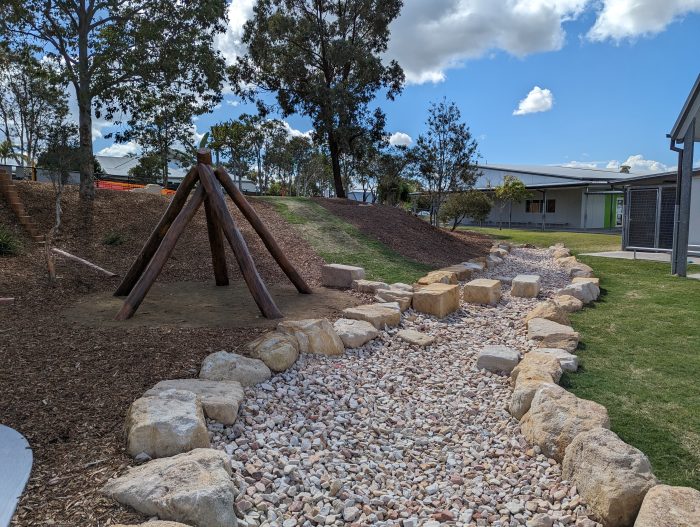
From occasional floodplain to functional, popular playspace: creating a nature playground at Norfolk Village School.
This project at Norfolk Village shows just how possible it is to create a nature play garden. We specialise in helping schools maximise their environment for accessible play. We can also support schools to bring nature play into the school grounds physically and pedagogically. Please reach out if you’d like to talk about how we can support your school.
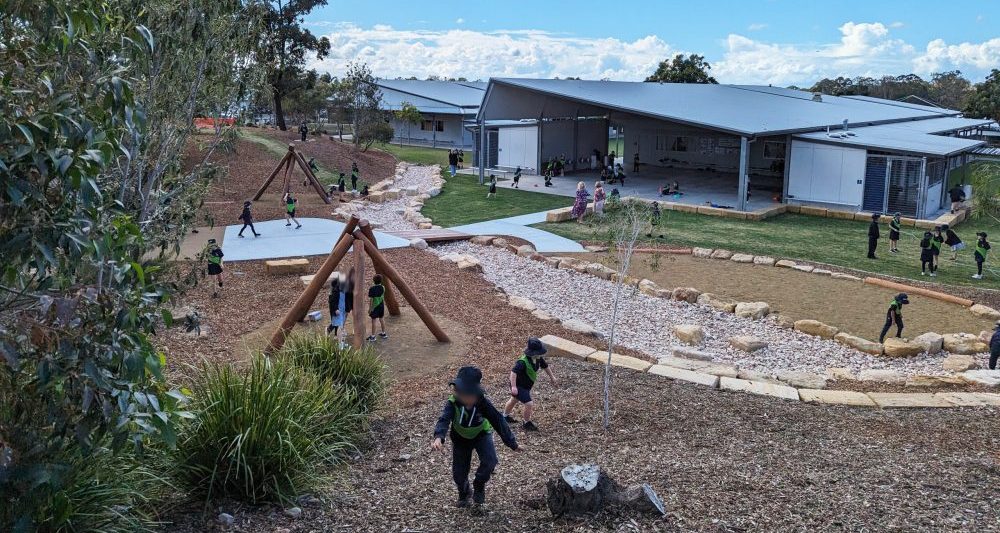
Here at Orterra we love working with the education sector to help them create spaces that both students and teachers value. One such example is the nature play garden at Norfolk Village State School, an independent public primary school on the Gold Coast where we worked with leadership team to transform a large area of unused land on the grounds from an inaccessible space prone to flooding into a play space that maximises the geographic footprint, serving the largest number of students possible.
Norfolk Village initially reached out to Orterra as the recipients of a grant to support their out of hours school care program. As landscape architects, our approach is never cookie cutter when working with any of our clients, schools included. Instead, our process is individualised. With Norfolk Village, we started with an exploration of how the concept of nature play fit within the school for both its master plan as well as in the context of servicing the OHSC program, taking into consideration the why, how and where before detailing the possibilities.
The school realised through obtaining the grant there was an opportunity to rethink play across the school and benefiting all students within the school community. The school wanted an alternative to traditional playgrounds, to maximise the space and to have a space that supported students in developing creativity and problem solving. Additionally, the school has done a lot of work as a community to develop their knowledge of First Nations’ perspectives and connection to Country. These goals were deemed as important to any design process and Orterra’s comprehensive, expert advice in relation to the impact of nature play aligned perfectly to these goals.
While taking into account Water Sensitive Urban Design principles to manage the existing drainage and water issues that had previously made the site unappealing and at times inaccessible, we created a design that wasn’t solely for this specific project, but the broader perspective of the school as a community, now and into the future. We also spent a lot of time in the planning stage creating a data set that informed our design, namely observations of student play habits, traffic flow, movement and access. This allowed us to design a playscape that didn’t just look good—although aesthetics are important to us – but one that serviced the community of students and teachers.
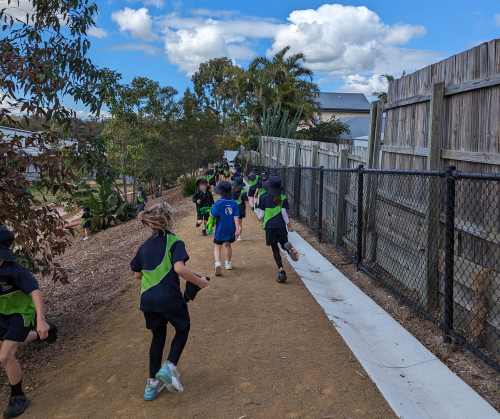
An initial project goal was to ensure alignment between all the stakeholders of the nature play garden, including staff and students. This is how we could collectively create shared ownership of the vision and purpose of the garden: a space where children engaged with the space through active play as well as imaginative and creative play.
The response from teachers has been as positive as that of students. Initially in the planning stages, educators were on board with it conceptually, and then as it launched with an ‘opening ceremony’ teachers began using the space for explicit teaching.
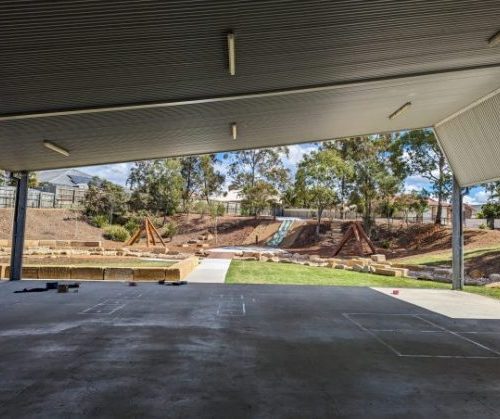
Of particular note is some of the observed changes in student behaviour:
- Students are more active and engaged in physical activity such as running and climbing
- More creative play; and
- Less students accessing supported play
These indicate that children and teachers feel safe to play in the space, which as landscape architects, brings immeasurable joy, particularly as there wasn’t a lot of play value in the space originally. Instead, now there is a space within the grounds safe to access, one where the students and teachers love to spend time.