
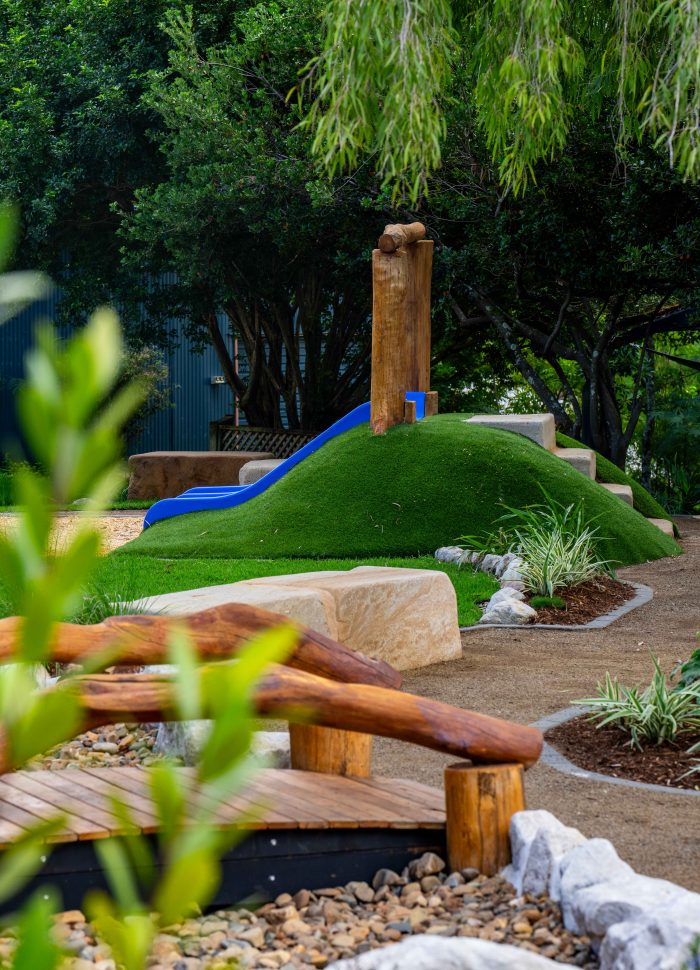
A school court can be a busy place at lunchtime. There is a game underway, a group waiting for their turn and students watching from the edge. Nearby, others might be looking for somewhere to talk, try something new or spend a quieter break with a friend. All of these students belong in the design conversation. At Orterra, we look at how sports spaces and their surroundings can support the different ways students play, connect and spend time outdoors. The court is an important part of that picture, and the landscape around it deserves careful consideration too.
The University of Canberra’s Schoolyard Greenprint provides evidence to support this broader approach. Its research into Australian secondary school grounds found that many students wanted more comfortable, shaded and quiet places to spend time, relax and connect with friends. Those needs extend well beyond providing somewhere to play sport.
Look at the edges of the activity
The line markings tell us where a game is played. They tell us much less about what happens around it. Students need places to wait, watch, rest and move between activities, and these spaces shape their everyday experience of the school grounds. A shaded place to sit can let a student stay connected to friends while taking a break. A gathering area beside a court can support conversation without spilling into a busy route. Clear connections can help students move through the grounds without needing to cross a game. At Orterra, we consider these relationships as part of designing the sports space itself. We ask what happens before a student joins in, when they need a rest and when they would simply prefer to watch.
Make room for different ways to participate
Some students love a competitive match. Others enjoy practising a skill with one friend, inventing their own games or watching before deciding whether to join. Their interests, energy and confidence can change from day to day. Diversity is an important part of the discussion when designing these spaces. For us, the practical design question is how to make room for those different experiences. Is one activity occupying almost all the available space? Can someone spend time near their friends without joining the game? Is there somewhere to move, explore or take a quieter break? Answering these questions helps us understand whose needs a space currently serves and where something may be missing.
Make comfort part of the design
Providing a seat is a starting point. Its location, shape and relationship to other seats influence whether students can comfortably use it together. Our work shows that students report insufficient seating even where benches and picnic tables were present. This is backed by the recent Greenprint study. Students often sit on the ground or improvising places to perch. Issues often include whether the furniture suited how students wanted to gather and relax or arrangment of seating.
One of the things we notice is that counting the number of seats only tells us only part of the story. We also need to consider whether friends can sit together, whether shade is available and whether there is a choice between a busy social setting and somewhere calmer. Seating and a choice in seating is a core part of having successful spaces for schools.

Listen before deciding what is needed
Adults might identify a need for more courts or additional seating. Students can help explain what those improvements need to do. At Orterra, understanding the people who use a place comes before deciding what it should become. That means hearing from students who use the courts regularly and those who spend their breaks elsewhere. Both can help us understand the whole school experience.
Let the landscape contribute
The surroundings of a court offer opportunities to bring planting, shade and informal exploration into everyday school life. Trees need space to establish, gathering areas need useful connections and quieter places need thoughtful positioning. These decisions must work alongside supervision, ball movement, accessibility and maintenance. A quieter space, for example, needs to balance a sense of retreat with appropriate visibility and school management requirements. Our design response is to consider these needs together. The landscape should support the practical operation of the school while offering students more choice in how they spend their time outside.
Design for the whole lunchtime
Adolescents have particular social, emotional and physical needs. Its findings strengthen the case for looking beyond sporting provision when considering how school grounds serve students. For us that translates into a clear design purpose: make room for the game and the school life around it. A student should be able to join in, watch, rest or connect with friends, with thoughtful spaces supporting each experience.
If your school is considering improvements to its outdoor spaces, talk to Orterra about creating places that respond to your students and the ways they use their grounds.
Because Outside Matters.
References and further reading
Schoolyard Greenprint project and resources, University of Canberra